Wednesday, April 15, 2015

Roboethics

Robots. From the time entertainment in the form of science fiction came about, they have been present; more times than not as the antagonists, seen destroying cities and wreaking all sorts of havoc. However, in today’s technological world, they are seen everywhere: not just on the silver screen like in The Matrix or Terminator, but in real life.


Many of these advancements in robotics are the reason the world is the way it is today, and many would like to see a future full of robots; but others think we are headed down a slippery slope of artificial intelligence. I myself, fall more in line with the thinking of the former.

Robots are Already Here

Much of the opposition to robotics has been brainwashed by Hollywood to believe that any type of robotics will eventually lead to artificial intelligence (AI) that tries to take over the world and exterminate the human race. What they do not like to realize however, is that we have had robots for decades.

The vast majority of machines in factories are robotic in nature, and have some sort of AI programming that controls everything from determining how far to cut a piece of metal, or how fast to move an assembly line.

“But That Doesn't Mean They Can’t Still Turn on Us!”

For the entirety of the time humans have had robots, we have always had control over them. Everything from power supplies, to what actions they can and cannot make are all controlled and programmed by humans. Even as AI becomes smarter more independent, we can always program a robot to do only what we want, and create fail-safes so that they could never do anything it was not intended to do. According to author and professor of biochemistry Isaac Asimov, there are three laws of robotics appropriately called “Isaac Asimov’s ‘Three Laws of Robotics’”
  1. A robot may not injure a human being or, through inaction, allow a human to come to harm
  2. A robot must obey orders given it by human beings except where such orders would conflict with the First Law
  3. A robot must protect its own existence as long as such protection does not conflict with the First or Second Law.

If humans begin to make robots with intelligent enough AI that they have their own “free will”, these laws could all be programmed into them as to ensure there could be little to no ill effects of robots.

They Benefit Us


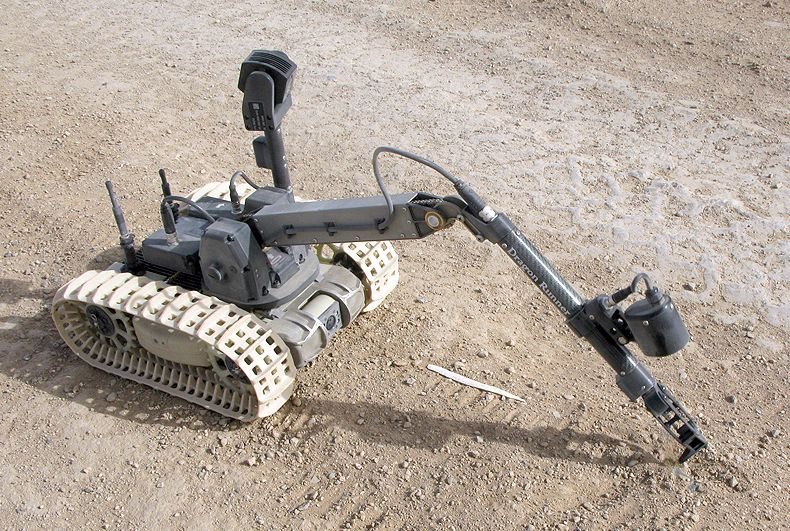
The machines we make have helped to make the world the way it is today. There are robots (nanobots) today that are in development that are so tiny that they can be injected into people’s bodies and seek out and destroy cancer cells. There are robots that can disarm bombs so that we do not have to risk a human life by sending a person in to defuse it themselves. Someday there could be robotic police officers and soldiers so that there would be no more humans dying in the line of duty. Robotic advancement must continue for the sake of humanity.
Thursday, April 2, 2015

New, Affordable 3D Printer in the Works?

Could a new, much less costly 3D printer be coming to the market in the near future? The owners of a new Kickstarter campaign believe they could be the ones to bring such a device to consumers.


Who/what/why?

The group called Tiko 3D says they are now able to produce a 3D printer that would be much less costly than comparable printers on the market currently. The group of inventors began as consumers, but became frustrated with the repeated disappointment experienced with using other 3D printers being “heavy, over-complicated, and unreliable”, so they decided to create their own. If it gets the backing needed by the group, Tiko will be able to be sold for just $179: hundreds of dollars less than their closest competitors.


Skepticism is evident…

Other manufacturers of 3D printers are extremely skeptical of the feasibility of the Tiko printer; and rightfully so. The majority of smaller groups/companies that have tried to produce lower cost 3D printers have had to shut down before they even actually got started, simply because many of the components that are found within the devices are plain expensive. This makes it difficult to sell below a certain price point while still maintaining a margin of profit that is high enough to merit the continuation of producing the devices.


So, how can they do this?

With the skeptics about, it begs the question: how can they actually produce Tiko at the cost they say they can? According to the Tiko 3D group, the key to the low cost of the Tiko is the “unibody” structure. Rather than other 3D printers having multiple rails to form the frame (the most expensive part of a 3D printer), Tiko has a single piece in which all the arms attach to allow the extruder head to move. This single piece structure then allows for higher reliability with more precise prints and easier maintenance, in that much fewer calibrations would have to be performed in order to keep the machine in proper working order. This is because rather than having multiple rails that can all move independently, Tiko has the unibody frame so that the whole device is essentially one working piece that moves together. The printer would also be extremely lightweight and portable, being only 3.7lbs; and since Tiko uses nonproprietary filament on a standard spool, you are not restricted to any certain material. One thing to remember is much of this information is hear-say, and whether or not Tiko 3D would actually be able to pull it off is another story.


What does this mean to consumers?


If a well-built, reliable, and high-functioning 3D printer enters the market at a price point of only $179, it could mean that anyone could be able to have a 3D printer (which is what Tiko 3D says they want). It could also put a lot of pressure on Tiko 3D from other companies to sell the rights to Tiko to the larger market shareholders such as MakerBot. In any way, it would be great for a product like Tiko to come out onto the market to help push other companies to making more affordable printers so that everyone can make their own little odds and ends if they so wish.

Tuesday, March 24, 2015

Boeing's "Force Field"

The Innovation

On March 22, 2015, it was announced that Boeing had patented the concept of what could possibly be the world’s first “force field”. Simply the thought of a force field seems as though it should be reserved for the science fiction writers, only to be seen on the big screen; which is why I am going to be taking a look at the idea as a whole with regards to:
  •         What the innovation is,
  •          What it would mean to the world, and
  •          The feasibility of the idea.


The Concept

The general idea behind the “force field” concept, more particularly (and accurately) referred to as a “method and system for shockwave attenuation via electromagnetic arc” is one that the scientific community has sought after for years, ever since Star Trek and Star Wars and a whole menagerie of science fiction stories have been around.
The physics of the device would be fairly straightforward. The invention would be designed to disrupt shockwaves from explosives in order to protect vehicles or buildings from these damaging waves. It would achieve this by using a sensor to detect a shockwave (most likely through pressure changes or flashes of light caused by an explosion) and an arc generator. The generator would receive a signal from the sensor and, using lasers, would ionize an area around the desired vehicle or building, creating a plasma field. This field would have different physical properties than the surrounding medium, and therefore would (at least partially) protect the desired object from the shockwaves that would otherwise damage it. It would not however, prevent shrapnel and other debris from penetrating the field.
The patent specifically reads, “Such embodiments as described above may reduce the energy density of the shockwave by creating a second medium in the path of the advancing shockwave that reflects, refracts, absorbs, and deflects at least a portion of the shockwave.


What Does This Mean?

With the increasing use of IED (improvised explosive device) weapons and other explosives in today’s modern warfare, the threat to military vehicles from explosives is very real. The shockwave attenuation system would be invaluable in all military vehicles, as well as airplanes (from proximity airborne explosives), and buildings. The system would also be incredibly useful in aquatic vessels such as large ships since explosions are amplified by going through a non-compressive medium such as water. As far as military defense goes, this would be a game-changer.


How Feasible is the Idea?

The idea itself is definitely possible. Boeing has reportedly already done a fair amount of testing of the idea on a small scale, so we know it is not far-fetched. The feasibility of equipping every military vehicle/vessel/aircraft/building with these devices however, is questionable.
First, you have the issue of size. It is undetermined how large such a device would have to be to adequately protect a vehicle such as a HUM-V, but when you are looking at an object as large as something like the supercarrier USS John C. Stennis (pictured below), measuring in at a staggering 1092 feet in length and displacing 103,300 tons of water, you can only imagine the scale of a device needed to protect such a vessel. Second, you would have to look at cost. As it has not been stated how much a shockwave attenuation device would cost, one can only estimate; but in order to equip all (or at least most) military vehicles with them, it would more than likely be a massive sum of money. Third, there is really no way of knowing when this concept could become reality, so until then, we will have to stay living in our science non-fiction world.


(credit official US Navy photos, defense.gov)

Tuesday, March 3, 2015

Explanation of Mechanical Engineering

Hello, and welcome to my first blog post!

As the title so clearly mentions, this post is all to do with mechanical engineering, which happens to be my field of study. For those of you who don't know, mechanical engineering is the discipline that applies physics, material science, and engineering to create and analyze machines. It is easily the broadest and most widely practiced form of engineering, without which life would not be the same as we live it today. Mechanical engineering as a whole is involved in practically everything that exists that is not made by nature. Whether it is your computer, a water bottle, or even a bag of potato chips, very little of anything we have today would be possible without the help of mechanical engineering. The general purpose of mechanical engineering is simply to make things. A key value of mechanical engineering is to make things that will improve the quality of every day life around the world. From nanobots that can attack cancer cells, to a gas cap that doesn't make your hands smell like gas when you're at the pump, improving quality of life is generally an important part of the job of an engineer.

Every factory you have ever seen is the product of a mechanical engineer's hard work. You know the car you drive to work every day? Let's take a minute to analyze exactly how that car came to be, working backwards. You have a car which was assembled in a factory with robots, machines, and hand tools, all of which are engineered products. To make those, engineers had to design and construct other machines prior, in factories with other robots, machines, and hand tools (so on, so forth). In order for the tools to be made, they had to have raw materials, which are gathered with rigs that were engineered (back to the factories, robots, and tools).

Just think of where we would be without mechanical engineering. The first "machine" is often to be considered the plow or lever. Now if you think about when those were invented (around the time the Egyptian Empire first came about), if they had not invented the plow and nobody else from then on invented anything else, you wouldn't be reading this right now. You would probably be outside tending to some sort of livestock, or using a small spade to plant crops, or perhaps trying to tell time with a sun dial (or not, if it's night time).

These are just a couple of a seemingly infinite number of examples portraying the necessity of mechanical engineering in today's world. Here's a picture of a Bugatti Veyron to remind you that without mechanical engineering, this wouldn't exist. Enjoy!